

how to record a life.
...proof you were here.

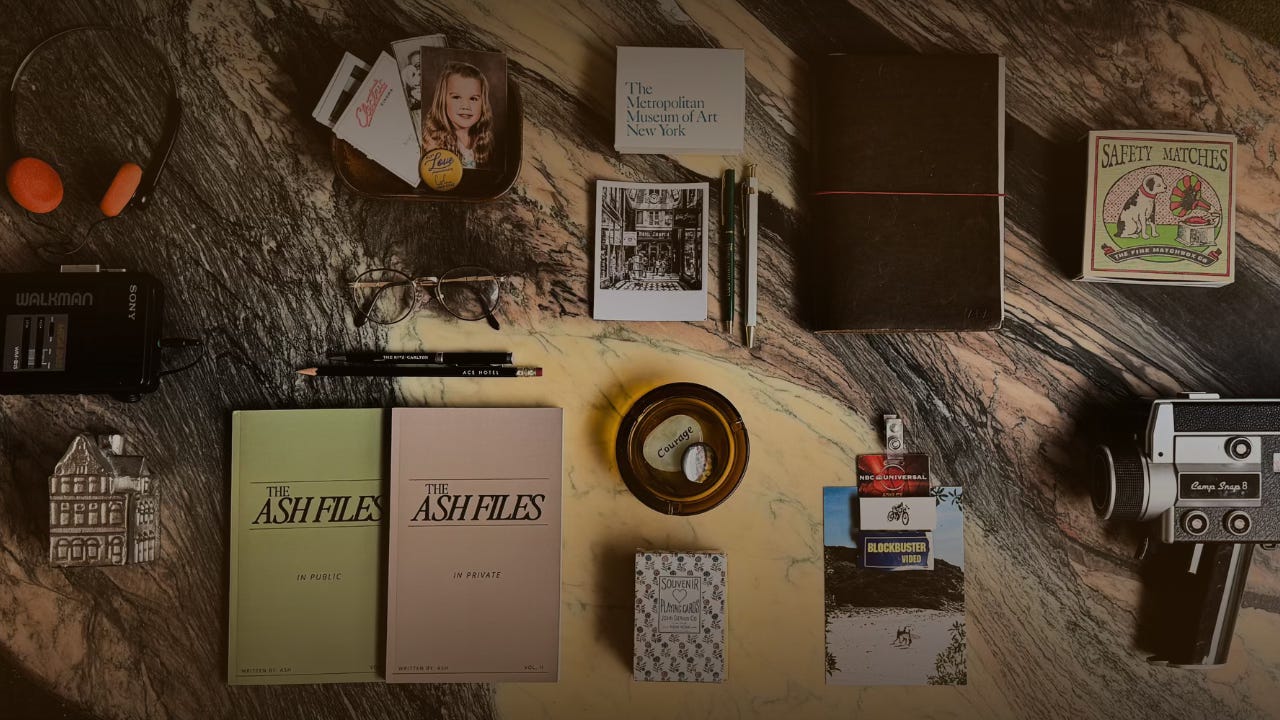
Why do we keep things?
Not objects necessarily… not the books or receipts, or the sweaters that still smell faintly of a place or person we left. Not the ticket stubs or the cracked mugs that survive every move. I mean the other keepsakes, the unfiled fragments. The screenshots of text messages we once thought were revelations. The playlist we can’t play anymore because it belonged to a version of us we outgrew, or were forced to. The necklace sitting at the back of the drawer, not because it’s valuable, but because discarding it would feel unreasonably final. A travel plan from a summer we were convinced we’d never forget, though of course, we already have.
Our devices have become a kind of attic. Not the nostalgic kind filled with heirlooms and sealed letters, but the one where things are placed “temporarily” and remain for years. Bits of days tucked away. A note written mid-thought, a photograph saved before it was edited, a recording of a conversation that didn’t matter until it ended.
They wait there, silent and unassuming, until we return to them and feel that odd jolt of recognition:
Oh. I knew this once. I lived this once.
Maybe that’s the reason we don’t delete. Not because we’re sentimental, though we are, in our own reluctant ways. But because we like the illusion of continuity, that if we could just collect enough fragments, we could reassemble the person we were before everything tilted slightly. Or maybe it’s simpler: we’re afraid that if we stop saving, we’ll stop existing. That without the trace, the day or the life itself, never happened.
And yes, there’s a touch of absurdity to all of this. The reverence with which we guard items that would mean nothing to anyone else. The way we catalogue ourselves, not out of vanity, but out of instinct. Under the old birthday card and the broken hair clip and the photo booth strip that caught your worst angle is a version of you that made sense, once. You keep these things, not because they’re beautiful or useful, but because they once made sense. Or maybe because you did, when you had them.
Think of the way a child pockets a stone, not because it’s rare, but because they found it while something was happening, and the stone remembers for them.
We aren’t so different, we just have bigger, better pockets now.
If you look long enough, your life begins to reveal itself in what you held onto without quite realizing you were keeping it.
We like to imagine there’s intention, but half of it is laziness and the other half is sentiment we’d rather not discuss.
Still… there it all is.
Proof you were here.
I’ve always kept track.
Of people. Of phrases. Of things I should’ve said differently. I don’t remember everything, but I do remember how everything felt — the way the light hit the table during a conversation I no longer speak of, the way someone’s voice changed mid-apology (or mid-non-apology).
I kept all of that, the way some people keep photographs. Mine just happened to take the shape of sentences.
I’ve kept things longer than any reasonable person would. Receipts from restaurants that don’t exist anymore. Keys to apartments I’ll never enter again. A t-shirt I didn’t even like, but was wearing on a day I still think about.
Most of its junk. But some of it, somehow, isn’t.
Writing was always the way I stayed in the room, how I kept a moment from dissolving. It was my way of turning a moment into something I could carry, control, return to. Kind of like an inventory, a system of labeling things that might otherwise get lost.
The essays weren’t essays at first. Just fragments.
Most of what I’ve written started as a sentence I couldn’t stop circling around, something said under my breath in a conversation that wasn’t going well, or that I muttered to myself while standing in line at the grocery store. The kind of thought that arrives fully formed and then disappears unless you grab it by the tail. They began to stack up, and eventually, I let them out — posted them, read them, gave them shape. Not because I wanted anyone to clap, but because I didn’t want to forget who I was when I wrote them.
But something I couldn’t let go of was that these weren’t just pieces of writing — they were a version of me. From a very particular stretch of time. A stretch I can’t quite explain, but knew I had to mark.
I think that’s what these essay collections became, almost accidentally — a place to hold all those sentences before they got flattened by time or turned into something more palatable. They’re not artifacts, but they’re not noise either.
This was never about turning my life into content. I don’t have the stamina for that kind of performance. It was just a way of saying: I noticed this. I felt this. It mattered for longer than a second.
That’s all.
And if you read any of it, if you paused even briefly, then you were in the moment too. Not as an audience. Just… in it. With me.
Maybe that’s all these things are, in the end… a record of a small intersection. A place where two people recognized something at the same time.
And maybe this is just the record we both needed.
I used to think the important part was catching things while they were happening, as though life were constantly slipping through my fingers and I was the only one who had noticed. I treated conversations like historical records in danger of being lost, which, in hindsight, made me insufferable at dinners. I’d pause to mentally underline a sentence someone said, trying to preserve the moment instead of experiencing it, but really I was just interrupting it. The irony is almost embarrassing but it was an earnest impulse, and like most earnest impulses, deeply misguided.
Life rarely presents itself in complete thoughts. It arrives half-finished, a little blurry, usually at the wrong time — like someone knocking on your door just as you’ve sat down. It doesn’t wait for you to be ready. You only understand what it was later, when you’re not holding on so tightly.
Eventually, I realized the moments I tried hardest to hold onto were always the most temporary. The things that stayed were the ones I didn’t try to preserve… apparently effort was the surest way to lose them. A line someone tossed out while looking for their coat. The faint stale warmth of a room near the end of the afternoon. A look across a dinner table I thought I assumed dissolved with time, until it showed up again when I got the whiff of a certain kind of hand soap.
Memory is selective in ways I will never understand, I’ve stopped pretending I have a say.
Most of recording a life happens after the fact. Not in the moment, but in the way you tell the story later… at dinner, in the kitchen, on the phone, and suddenly you hear yourself say it differently. The circumstances remain the same, but the interpretation becomes the only thing with a pulse.
It turns out we don’t archive our lives, we revise them.
No one’s lying, we’ve just changed. Who we were when we lived it is never the same as who we are when we remember it. There’s no holding anything exactly as it was, there’s only the part that insists on being kept.
So the “how” isn’t a method or a system. It’s simply a willingness to notice what stays. Not out of effort, out of familiarity. The things that mattered will always tap you on the shoulder and almost always when you hear yourself insisting you don’t care.
You don’t have to hold onto everything so tightly. What lasts is whatever refuses to leave. The rest was never yours.
Of course we were trying to save the moment. What else were we supposed to do with it? Just let it pass through and vanish? We’re not built for that kind of casual relationship to our own lives. When something happens, whether it be a look, a sentence, a brief flicker of being fully awake, the instinct is to keep it, to hold it by the sleeve and tell it to stay.
But it never works the way we want it to, because the moment never survives the handling. It changes shape the second we look at it too hard, like trying to press a flower between pages and then being surprised when it dries. There’s no preserving anything in its original state. By the time you’ve realized something mattered, you’re already remembering it.
And yet… we keep trying. Not because we believe we’ll succeed, but because something in us insists it’s worth the attempt. We want proof that we weren’t just passing time, but that we noticed and that we didn’t sleepwalk through our own days.
The keepsakes, the sentences, the screenshots… they’re not the memory, they’re the gesture of reaching for it. Evidence that, at least once, you were paying attention. That you were inside your own life and not just watching it happen.
The irony in all of this is that the act of keeping something often drags you straight out of the very moment you’re trying to hold onto. We’ve all done it, the reflexive reach for the camera to film a video at a concert that you’ll never rewatch. Or the way you start composing the caption in your head, or angle your body toward the better light, missing the event around you entirely. You go from being in it to watching yourself be in it. One second you’re laughing, the next you’re observing yourself laughing. And once you’re in that mode, the moment is already dissolving.
There was a time when taking a photo meant you got one, maybe two, and you hoped you didn’t blink. You were capturing the moment, not directing it. Now we take thirty pictures of the same sunset and somehow end up remembering none of them.
Being there was the record, everything after that is commentary.
If there’s any proof we were here, that’s it.
There’s a difference between remembering your life and watching it happen in real time from a few feet away. Most people don’t notice the distance until it’s permanent. You can feel it if you pay attention, that slight click of stepping outside the moment so you can observe it, manage it, frame it. It feels efficient, almost responsible, but it’s actually the fastest way to miss your own life while it’s happening.
The moment doesn’t need your supervision. It doesn’t need to be curated, captioned, optimized for future consumption, or documented from every angle. It just needs someone to be in it while it’s happening. Fully. Poorly. Without thinking about how it’ll read to someone else… including yourself.
The photo will never be the moment, it’s always only the echo. The recording will never sound the way it felt, it just confirms something occurred. And the screen will always create a small, barely perceptible separation between you and your own experience — the very thing you were trying to keep. It’s small at first… then it isn’t.
So yes, you put the phone down. Not forever, not because technology is ruining your life (though one could make the argument), and not because you should be more “present” or whatever slogan is currently being sold back to us. Put it down because you already know what the moment feels like when you’re actually in it, long enough to let the moment be the moment, instead of the evidence of one.
The “how” was never complicated, just embarrassingly simple.
You live… You notice… And you keep moving.
The record is made either way.
OFFERINGS
The Raconteur — capturing, seeing, and saying it your way. A place to give your voice its shape. —> Pre-order now 🎥📝📺
Books - The Ash Files vol. I + II
The Ash Files — Where life’s unexpected moments get filed away — sometimes neatly, sometimes under “figure it out later.” From writer/creator ASH, expect weekly musings, honest stories, and a reminder that no one has life entirely figured out [least of all me].✨
What an inspired and inspiring piece of writing. Thank you Ash. I savoured every word. Your insight and eloquence are both beautiful. Lynn
"But something I couldn’t let go of was that these weren’t just pieces of writing — they were a version of me. From a very particular stretch of time. A stretch I can’t quite explain, but knew I had to mark".
Reading this line just gave me chills and made remember the 11th doctor's (Matt Smith) final speech in the BBC show ~Doctor Who~ when he said:
> “We all change. When you think about it, we’re all different people all through our lives. And that’s okay - that’s good. You’ve got to keep moving, so long as you remember all the people that you used to be. I will not forget one line of this. Not one day. I swear. I will always remember when the Doctor was me.”
And I think this line really speaks volumes, because all through our lives, we' are different versions (some amazing, others not -so-pleasant) and that is just Beautiful. 🤍